In January 2020, researchers at OpenAI published a paper called “Scaling Laws for Neural Language Models”. It was, in effect, a recipe: make the model bigger, feed it more data, train it with more computing power, and its performance improves, not vaguely but along a smooth curve you can draw in advance. Two years later researchers at DeepMind refined the proportions, showing that most models of the day were too big for the data they ate. Rival laboratories in the most valuable technology race in history had published their cookbooks. Stranger still, everyone then followed the same recipe, and kept following it even as the cost of each batch climbed from millions of dollars towards billions. Why publish? And why does an industry full of clever people all cook the same dish?
Economics has a name for what those papers describe. A production function is the relationship between what goes into making something and what comes out: so much land, labour and fertiliser yields so much wheat. Every industry has one, but in most industries it is murky: nobody can tell you precisely how much more car you get per additional engineer. What the scaling-law papers did was measure the production function of intelligence, and the result was a shock of orderliness. The inputs are compute (the raw processing applied during training), data (the text and images the model learns from), the researchers who design the training run, and the electricity that powers it. The output is capability. And the relationship between them held so smoothly, across many orders of magnitude, that labs could predict the abilities of a model costing hundreds of millions of dollars before committing the money. Few factories in history have run on so legible a recipe.
That orderliness answers the puzzle’s second half. When output is a predictable function of inputs, competition stops being a lottery of genius and becomes a procurement race: whoever assembles the most compute, data, talent and power wins, and everyone can see it. So the industry behaves accordingly. The computing power used to train frontier models has grown four- to five-fold every year, as of mid-2026, according to Epoch AI. That pace, sustained over a decade, multiplies the input bill by more than a million. The half-trillion dollars of chapter 1 is the recipe being followed at industrial scale. Publishing it, far from giving the game away, advantaged the labs that could spend most: a public recipe whose key ingredient costs billions is not much of a gift to small rivals.
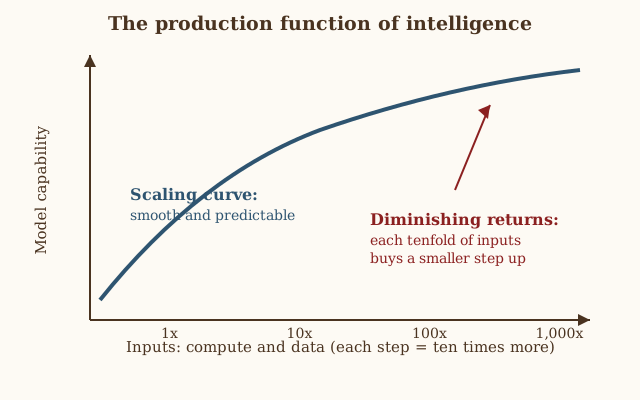
But the same curve contains the race’s brake. The scaling relationship is what mathematicians call a power law, and in plain words it means this: capability rises with inputs, but each equal step in capability requires multiplying the inputs. Ten times the compute buys one step forward; the next step costs a hundred times; the one after, a thousand. It is a close cousin of what economists call diminishing returns (here the returns fade even when every input is multiplied together), and it turns the recipe into a forecast of trouble: inputs that must grow tenfold on schedule eventually hit a wall. The economics of the next few years of AI is largely the question of which input hits its wall first.
Data may be the nearest wall. Epoch AI estimates the stock of public, human-written text at roughly 300trn tokens, and projects that if training trends continue, frontier models will have consumed it sometime between 2026 and 2032. The industry’s responses are visible in the market: licensing deals with publishers, lawsuits from those not asked, and growing use of synthetic data, with machines writing the textbooks for the next machines and the consequences still being argued over. Power is the most physical wall: the electricity required to train frontier models has been doubling annually, by Epoch’s measure, on the way to the Japan-sized claim on the world’s grids that chapter 2 described. Chips remain bottlenecked through a handful of firms, the subject of chapter 5; and money, the input that buys the others, is the wall the bubble debate of chapter 9 worries about.
Then there is talent, the input that behaves least like the others, because its supply barely responds to price. When Meta tried to staff its frontier lab in 2025, reported pay packages for a handful of senior researchers ran to $100m or more. To a layman that looks insane; to an economist it looks like rent, the surplus a scarce input commands above what would keep it in its next-best use. The people who have actually run frontier training know things written in no paper, and the world contains very few of them. When a recipe is public but the chefs are scarce, the chefs capture much of the value. High pay is here doing exactly what prices are for: signalling scarcity and recruiting the next generation into the field. Minting a frontier researcher takes years, which is why the rent persists.
One last question completes the picture: once the recipe has been followed and the model exists, what kind of input is it in everyone else’s production function? A trained model is capital, a produced asset, like a lathe or a power station; but capital of an unusual kind, because the work it does is the work that was labour’s last refuge: writing, analysing, deciding, predicting. The economist Joseph Zeira formalised the consequences in 1998. He showed that if machines can progressively take over tasks from workers, growth comes to depend on accumulating machines, while the fate of wages depends on which tasks remain human. Nearly every modern analysis of AI and jobs is built on that foundation. The recipe this chapter described is, in the end, a recipe for manufacturing capital that competes with people. That is why Part III of this book belongs to the people.
So the scaling laws are not laboratory trivia. They are the production function of a new industry, public and unusually predictable, and that predictability explains the race, the size of the cheques, the hunt for data and power, and the strange salaries. It also defines the limits: a recipe demanding tenfold more ingredients per step must eventually strain against the world’s supply of text, electricity, silicon and patience.
What to watch
- Epoch AI’s training-compute tracker: whether frontier compute keeps growing four- to five-fold a year, or the curve bends. This is the single best indicator that an input wall is binding.
- Capability gains per training run: if new frontier models start disappointing relative to their budgets, diminishing returns are outrunning the recipe.
- The data market: the volume and price of content-licensing deals, court rulings on training data, and how openly labs admit to relying on synthetic data.
- Grid-connection queues and power-purchase deals for data centres: electricity is the input whose scarcity shows up first in public infrastructure data.
Dig deeper
- Training compute of frontier AI models grows by 4-5x per year (Epoch AI): the input-growth data behind the procurement race.
- Scaling Laws for Neural Language Models (Kaplan et al., 2020): the original published recipe.
- Training Compute-Optimal Large Language Models (Hoffmann et al., 2022): DeepMind’s “Chinchilla” refinement of the proportions of compute and data.
- Will we run out of data? (Epoch AI): the 300trn-token estimate and the projected exhaustion window.
- Energy and AI (IEA, 2025): the power wall, quantified.
- Meta is offering multimillion-dollar pay for AI researchers (TechCrunch, 2025): the talent market and what the reported $100m packages actually contain.