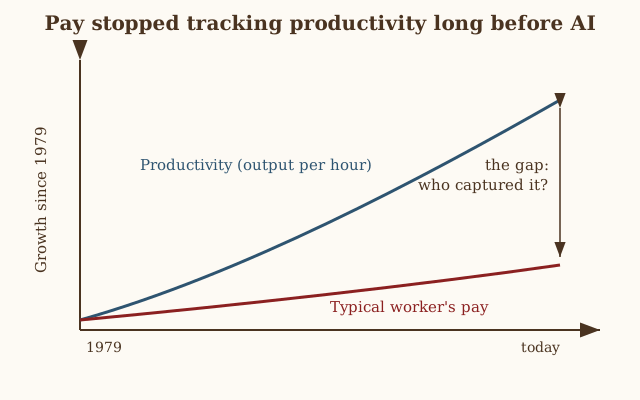
Americans are far likelier to expect AI to harm them (43%) than to benefit them (24%), and 64% expect it to mean fewer jobs over the next twenty years, while 73% of AI experts expect it to improve how people work, according to Pew’s surveys. The easy response is that the public misunderstands the technology. The harder, better response is that the public understands the economy. Productivity gains and ordinary pay parted company in America decades before AI: since 1979, by the Economic Policy Institute’s reckoning, productivity has grown roughly three and a half times as much as the typical worker’s pay. The size of that gap is genuinely contested: count fringe benefits, use matching inflation measures, compare like with like, and sceptics shrink it to a fraction of EPI’s headline. But even the most conservative constructions leave the typical worker’s pay trailing productivity, and the direction is not in dispute. People who expect to be passed over have simply been extrapolating.
The tool for thinking about this is factor shares. Everything an economy produces is paid out to someone, to labour as wages or to capital as profits, rent and interest, and for most of the twentieth century the split was so stable that economists treated it as a constant: roughly two-thirds to labour. Then, from about 1980, labour’s share began to slip in most rich countries. Automation is one reason: when a machine takes over tasks, the income those tasks generated moves from the wage column to the profit column. Acemoglu and Restrepo’s evidence suggests that automation of routine work explains a large share of the changes in the American wage structure since then. AI raises the stakes because it is capital that does cognitive work. Every previous machine left thinking as labour’s sanctuary; if capital can think, the question of how far the split can tilt stops being academic.
Within the workforce, though, AI is doing something the last technology wave did not, and an honest account has to hold both halves of it together. Computers favoured the skilled: they complemented graduates and displaced clerks, widening pay gaps for thirty years. The early AI evidence cuts the other way. In experiment after experiment (writers, support agents, programmers) the least experienced gain most, because the machine bottles the expertise of the best and lends it to the rest. That compresses gaps among those who keep their jobs. But between those who direct AI and those displaced by it, between firms that own the models and firms that rent them, the gaps widen. Inequality is not rising or falling; it is being rearranged.
Where it concentrates is described by superstar economics. When a market is winner-take-most (and chapters 4 and 5 showed why AI markets lean that way) the winning firm serves everyone with comparatively few employees, so more of national income arrives as profit in fewer hands. David Autor and colleagues showed that the rise of such superstar firms explains much of labour’s falling share even before modern AI. The geography follows the same script: a handful of data-centre counties collect the construction booms and tax receipts, a handful of metropolitan areas collect the AI jobs, and the stockholders who own the winners collect the rest. Gains this concentrated can leave the average rising while the median (the worker in the middle) stands still, which is precisely the world the Pew pessimists say they live in.
Between countries the ledger is stranger. The IMF estimates that about 40% of jobs worldwide are exposed to AI, rising to about 60% in advanced economies and falling to 26% in low-income ones (as of mid-2026). Exposure sounds like risk, and half of it is: the IMF expects roughly half of exposed jobs in rich countries to be at risk of displacement. But the other half stand to benefit from complementarity, and poor countries’ low exposure is not protection. It reflects economies short of the infrastructure, skills and capital that turn AI into income. Worse, the classic ladder out of poverty has been selling abundant cheap labour to the world. If AI makes cognitive work cheap everywhere and robotics does the same for factory work, the rungs that carried South Korea and China upwards may not hold the next climber.
It would be tidy to end with a law: technology raises inequality, or technology eventually lifts everyone. History supports neither. Daron Acemoglu and Simon Johnson’s survey of a thousand years of technical change found that who benefits is decided not by the machine but by the institutions around it: who owns it, who can bargain, and in which direction inventors point their efforts. Medieval windmills enriched monasteries, not millers, because the monasteries owned them. The first industrial revolution immiserated a generation; its gains spread only when unions, ballots and public schooling forced the sharing. The same technology can be aimed at replacing workers or at amplifying them (chapter 7’s Turing trap), and which way it is aimed responds to wages, taxes, labour law and corporate power, not to physics.
That is the resolution of the puzzle, and it is uncomfortable rather than reassuring. The public’s pessimism is not a misunderstanding of AI; it is a forecast about distribution, grounded in forty years of watching productivity gains land elsewhere. The forecast may prove wrong (the novice-boosting pattern in the early evidence is real grounds for hope), but it will be proved wrong by choices about ownership, bargaining power and the direction of innovation, not by the technology improving. Who wins from AI is not a prediction problem. It is a negotiation, and it has already started.
What to watch
- The labour share of national income in heavy AI adopters, the single cleanest indicator of capital winning or labour holding.
- Wage growth at the bottom and middle of the distribution in AI-exposed occupations: does the novice-boosting pattern survive mass deployment?
- Concentration of AI profits: the share of stock-market gains and of AI revenue accruing to the five biggest firms.
- Developing-country exports of services and manufactures: early evidence on whether AI erodes the cheap-labour ladder.
Dig deeper
- AI Will Transform the Global Economy. Let’s Make Sure It Benefits Humanity (IMF): the 40%/60% exposure estimates and their distributional warning.
- Gen-AI: Artificial Intelligence and the Future of Work (IMF Staff Discussion Note): the full analysis behind the headline numbers.
- How the US Public and AI Experts View Artificial Intelligence (Pew Research Center): the expert-public gulf in expectations.
- The Productivity–Pay Gap since 1979 (Economic Policy Institute): the divergence that primed public pessimism.
- The Fall of the Labor Share and the Rise of Superstar Firms (Autor et al., NBER): how winner-take-most markets shift income from wages to profits.