By 2030 the world’s data centres are expected to draw about 945 terawatt-hours of electricity a year, slightly more than Japan consumes today, and AI is the biggest reason, on the International Energy Agency’s projections (as of mid-2026). In America, data centres account for nearly half of all growth in electricity demand between now and the end of the decade. The firms building them pay for every metered kilowatt. The more interesting question is what nobody pays for: the congestion on local grids, the water evaporated for cooling in dry counties, the machine-written sludge silting up the open internet, and a small but genuine risk that the technology goes badly wrong. Each of these is a cost that lands on people who were never party to any deal.
Economists call such costs externalities, and the dry word does a lot of work. A market price is a messenger: it tells producers what their activity truly costs and buyers what it is truly worth. When part of the cost falls on bystanders, the messenger lies. A data-centre developer weighs the costs it pays, not the costs it causes, and so builds more than an honest price would justify. No malice is required. It is what any of us does when part of the bill goes to someone else.
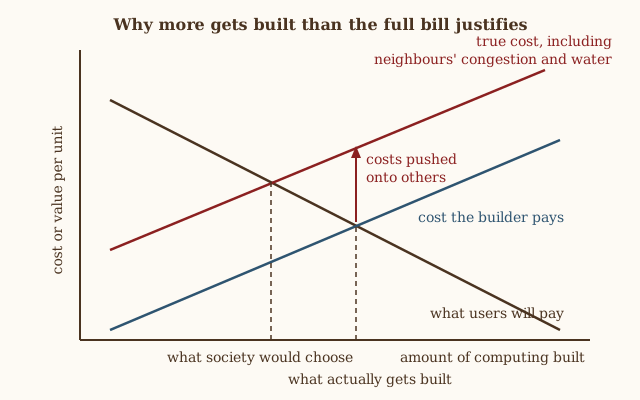
The picture above is the whole argument. The gap between the builder’s cost and the full cost is a wedge of expense pushed onto others, and the market settles at a quantity larger than society would choose if everyone paid their way. Applied to power and water, the wedge stops being abstract: about two-thirds of the American data centres built since 2022 sit in places already short of water. One distinction keeps the argument honest. A higher electricity bill, on its own, is not an externality. Paying more when demand rises is the price system working, and one national-laboratory analysis found data centres were not the main driver of price rises across most of the country through 2025. The true spillovers never reach a meter: congestion that degrades neighbours’ supply, water drawn from stressed basins, grid upgrades spread across every ratepayer. They are local, and in data-centre counties the strain has stalled tens of billions of dollars of projects against organised opposition.
The remedy is dull and powerful: price the spillover. Charge computing for the full cost of its power and water, the same logic as a pollution tax, and the boom will shrink to the size it is actually worth. Bans and moratoriums pick a quantity by politics; a corrected price lets arithmetic do it.
A second failure has no meter at all. The open internet is a commons, like a medieval grazing field: valuable to everyone, owned by no one. Generating a plausible web page, product review or scientific-looking paper now costs roughly nothing, and each one earns its maker a little attention or money while degrading, very slightly, everyone’s ability to trust what they read. That is overgrazing in its purest form. The villager who adds one more sheep keeps the whole gain and bears a sliver of the damage; the AI spammer who adds one more page does the same. Nobody owns the internet’s credibility, so nobody conserves it, and the costlier signals that chapter 11 predicted, from proctored exams to verified provenance, are the fences going up around the field.
Data itself fails in the opposite direction: it is underused, not overused. A spreadsheet of medical scans is what economists call nonrival: my using it takes nothing away from your using it, which makes it unlike a barrel of oil. Charles Jones and Christopher Tonetti showed that this property makes data enormously valuable in principle and badly allocated in practice: firms hoard what they hold, individuals cannot meaningfully sell or share what they generate, and society gets far less value from the resource than it could. Privacy is the genuine cost on the other side of the ledger; the point is that today’s arrangements were never designed to weigh the two.
The loudest fight is over property rights in training data. In 2025 Anthropic agreed to pay authors $1.5bn, roughly $3,000 a book, after an American judge ruled that training a model on lawfully obtained books was fair use but that hoarding millions of pirated copies was not; as of mid-2026 the New York Times’s suit against OpenAI was still grinding through the courts. Underneath the legal Latin sits a familiar trade-off. Copyright exists to keep the incentive to create alive; training transfers value from creators to model-owners at zero marginal cost, in what is either the largest uncompensated input transfer in history or a textbook beneficial spillover, depending on which side’s brief you read. The courts are, in effect, deciding where the wedge in the diagram sits, and a growing market in licensing deals suggests the parties would rather set a price than wait to be told one.
The mirror image of a harmful spillover is a benefit nobody can charge for, and AI has those too. Safety research, open evaluations and work on understanding what is happening inside models benefit every lab and every user, whether or not they paid, which is why racing firms underprovide them. No single shipowner ever paid for a lighthouse alone, since the beam guides every passing rival free of charge. That is why lighthouses came to be financed by light dues levied on all ships at the harbour, rather than by anyone’s goodwill. Chad Jones has framed the deepest version as a sober expected-value problem: weigh faster growth against even a small probability of catastrophe and society should spend heavily on safety, yet no single competitor in chapter 6’s race will fund that spending alone, because its rivals would share the benefit while it bore the cost. Lighthouses are a job for the harbour authority, not the racers.
So who pays for the electricity, the flooded internet and the risk? At present: neighbours, in bills and water tables; creators, in royalties forgone; all of us, in a degraded commons; and the future, in risk that nobody prices. None of this is an argument for stopping the technology. It is an argument for making prices tell the truth where they can, and writing property rights or funding public goods directly where they cannot. The market failures in this chapter are the economist’s honest case for government in AI. What a competent government would actually do, and how it regulates something that changes faster than legislation, is the next chapter’s problem.
What to watch
- The IEA’s annual data-centre electricity updates: is demand tracking the ~945TWh-by-2030 path, and is it being met by new supply or by other users’ higher bills?
- Whether data-centre permits start carrying full-cost pricing for power, water and grid upgrades, the pollution-tax logic arriving in practice.
- The New York Times v OpenAI ruling and its successors, and whether training-data licensing grows from settlements into a routine market.
- Public money for model evaluation and safety institutes, the lighthouse test of whether governments treat safety as the public good it is.
Dig deeper
- IEA, Energy and AI (2025): the standard reference for data-centre electricity projections.
- Jones & Tonetti, “Nonrivalry and the Economics of Data” (NBER w26260): why data is unlike oil and why its ownership matters.
- Jones, “The A.I. Dilemma: Growth versus Existential Risk” (NBER w31837): the growth-versus-risk trade-off as a calculation a layman can follow.
- The Authors Guild on the Anthropic settlement: what the $1.5bn deal means for writers.
- Carbon Brief, “AI: five charts that put data-centre energy use into context”: a sceptical, well-sourced reality check on the energy numbers.
- World Resources Institute on US data-centre growth impacts: power, water and community effects surveyed.