A wage is a price: the price of renting human time and skill, and it is positive for the same reason any price is, because the thing being sold is scarce and useful. So put the hardest question plainly: if machines could one day do every task a person can do, as well and more cheaply, what would a wage be? It is the limiting case of the model this book has used throughout, and the answer is uncomfortably clear.
Run the logic of chapter 3 to its end. Whenever a machine can do a task at lower cost than a person, no employer will pay the person more than the machine costs; today that disciplines some wages, but humans keep an income because many tasks still need them. Under full substitution that refuge closes. Wages get pinned at the cost of the machine equivalent, which compute trends keep pushing down, and the share of national income paid for work heads towards zero. Income flows instead to whoever owns the machines, the energy and the land they run on. For scale: labour’s share of income in advanced economies drifted from about 54% in 1980 to roughly 50% by the mid-2010s, on IMF figures, and that four-point slide is implicated in a generation of stagnant pay and angry politics. The scenario on the table contemplates not four points but fifty. In such a world “what do you earn?” matters less than “what do you own?”, which is why chapter 10’s argument, that distribution is a choice, becomes the whole game.
Before accepting that arithmetic, give the oldest tool in trade theory its say: comparative advantage. While machines remain scarce, and chips and electricity are finite, an hour of machine time spent on one task is an hour denied to another. It then pays to reserve the machines for the work where their edge is widest and leave people the rest, and wages survive, set by the value of that leftover work. The bleak scenario needs more than machines that can do everything; it needs machine capacity so abundant that none of it is worth rationing, exactly what the build-out of Part II is racing to supply.
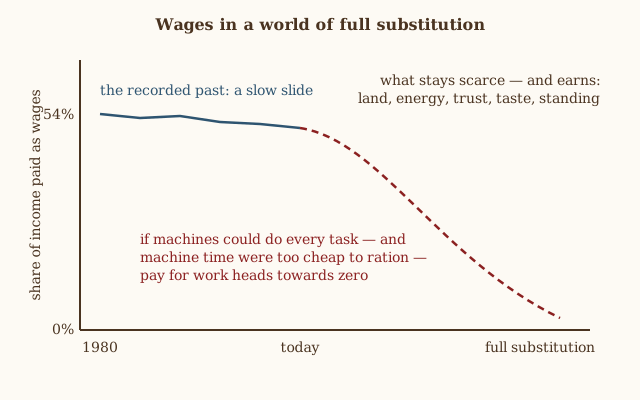
Even then, economics does not end. Scarcity is not abolished by clever machines; it relocates. Land in particular places, energy, raw materials, and the unreproducible human goods, such as trust, taste, status, attention, the front-row seat, the doctor a patient insists on seeing in person: none of these can be multiplied by running more software. The lesson of chapter 2 returns at full volume: when one input collapses in price, its complements soar in relative value. A world of free cognition is not a world without prices; it is a world where the prices that matter attach to everything cognition cannot conjure.
Whether that world arrives, and how fast, turns on a debate this book has visited twice. The explosive case puts AI into the ideas production function: if machines can do research, then better machines design still better machines, and growth could accelerate beyond historical experience. The braking case is Baumol’s, formalised for AI by Philippe Aghion, Benjamin Jones and Charles Jones: output is a chain of essential steps, and overall growth is set not by the fastest link but by the slowest, by clinical trials, planning permission, pouring concrete, persuading humans. William Nordhaus tested decades of data for signs of an approaching “economic singularity” and concluded it was not near: on his tests, not before 2100. Both camps can be right at once: explosive growth possible in principle, bottlenecked in practice, with the timing decided by how many essential steps stay stubbornly human and physical.
How should anyone act under a forecast that wide? The economist’s discipline for radical uncertainty is portfolio thinking. Anton Korinek advises governments to stress-test institutions against several scenarios: business as usual, machine generality in twenty years, machine generality in five, and to ask which policies are robust across all of them. Tax systems anchored to wages, safety nets anchored to jobs and pensions anchored to careers all fail in the later scenarios; reforms that broaden the tax base towards capital and decouple security from employment are cheap insurance even if those scenarios never arrive. And because the outcomes include a small probability of catastrophe, Chad Jones’s expected-value logic from chapter 12 applies at the largest scale: “probably fine” and “possibly irreversible” both deserve weight in the sum, so spending seriously on safety is arithmetic, not alarmism.
The far horizon, in the end, is not a forecast but a menu. Daron Acemoglu and Simon Johnson’s reading of a thousand years of technology says the gains from new machines went broadly only when institutions pushed them broadly, when the direction of innovation, the ownership of the machines and the bargaining power of ordinary people were contested rather than assumed. Every chapter of this book has ended at the same fork: automate or augment, concentrate or compete, price the spillover or ignore it, hoard the chips or trade them. Which world we get on the far horizon is the compound interest of those choices, made one rulebook, one lawsuit and one investment at a time.
This book has really been one idea wearing fifteen costumes. AI is a collapse in the price of something that was always scarce, prediction, and increasingly cognition itself, and everything else followed from asking what happens next: demand explodes and migrates to complements; production concentrates where fixed costs are vast and copies free; firms race, bubbles inflate, infrastructure remains; work is rearranged task by task, not abolished job by job; growth arrives late and unevenly; the gains pool unless institutions spread them; and states, late to every party, set the rules.
We have tried to be honest about what we do not know; that is why each chapter ends with things to watch rather than things to believe. Serious economists’ estimates of AI’s growth effects differ by a factor of twenty, and the history of steam, electricity and computing is a museum of confident predictions that missed. We might be wrong about timing, magnitude, even direction.
What will not date is the toolkit: supply and demand, fixed and marginal cost, market power, tasks and complements, externalities and public goods, the gains from trade and the failures of markets. These survived steam, electricity and the internet, and they will survive the machines. When the next astonishing headline arrives, the reader owns the questions that tame it: what just got cheap, and what does that make valuable? Who pays for the spillovers, and who pockets the surplus? What is genuinely scarce, and who owns it? The figures in this book will age. The tools will not.
What to watch
- Labour’s share of national income in the statistical agencies’ annual figures, the single cleanest gauge of whether the far-horizon scenario is approaching or receding.
- Real interest rates and asset prices: if markets genuinely expected explosive growth, long-term rates and the price of land and energy should say so loudly.
- The first credible cases of AI systems producing useful research autonomously, the precondition for the explosive-growth case.
- The prices of the bottleneck steps, such as trials, permits, construction and energy, relative to cognition; Baumol’s brake made visible.
Dig deeper
- Agrawal, Brynjolfsson & Korinek (eds.), The Economics of Transformative AI (2026): the research frontier on everything in this chapter.
- Aghion, Jones & Jones, “Artificial Intelligence and Economic Growth” (NBER w23928): the canonical treatment of AI, Baumol’s brake and singularity scenarios.
- Nordhaus, “Are We Approaching an Economic Singularity?” (NBER w21547): the data-driven sceptic’s test, and its verdict.
- Korinek, “Scenario Planning for an AGI Future” (IMF F&D, 2023): how policymakers can prepare for several futures at once.
- Jones, “The A.I. Dilemma: Growth versus Existential Risk” (NBER w31837): weighing enormous upside against small chances of catastrophe.
- IMF, “Drivers of Declining Labor Share of Income”: the recorded labour-share decline behind this chapter’s chart.