Brussels wrote its rulebook before the products had settled: the EU’s AI Act entered into force in August 2024 and bites in stages through 2026. Washington wrote almost no statute at all, leaving courts and agencies to pick over harms after the fact, and then, in December 2025, the White House ordered up a task force to sue American states whose AI laws it dislikes. Beijing requires model-makers to register their systems and pass official review before the public may touch them. Three governments, three philosophies. Who has the economics right?
Why regulate at all? “The technology is powerful” is not a reason. The economist’s answer is the menu of market failures assembled in the last few chapters: concentration that lets a handful of firms set terms (chapter 5), information problems that let machines mislead at scale (chapter 11), and spillovers that nobody prices (chapter 12). Where none of these applies, regulation buys nothing and costs plenty. Where they do, a rule is a purchase like any other: it buys harms avoided, and it pays in compliance burdens, innovation forgone and the occasional mistake enforced with the full majesty of the law. The question is never whether to feel strongly. It is whether the purchase is worth the price.
What makes AI hard is that the purchase must be made under genuine uncertainty, and both errors are expensive. Wait, and evidence accumulates: the regulator learns which harms are real, and the rules can be aimed rather than sprayed (economists call this the option value of waiting). But waiting has its own bill: harms compound, business models harden around bad practices, and the firms grow rich enough to fight any future rule. The regulator’s problem is a trade-off between acting too soon and acting too late, and the least-bad moment shifts every time new evidence arrives.
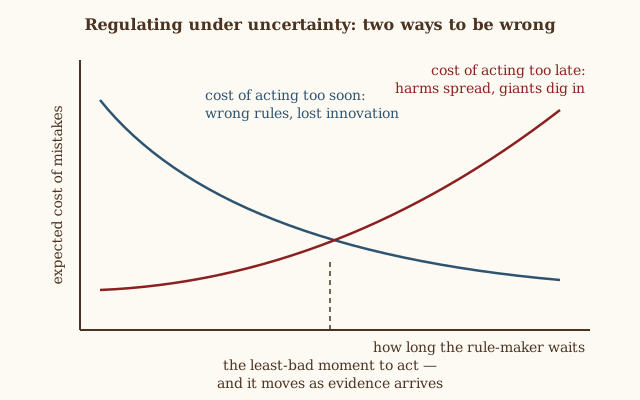
The record so far shows the target moving faster than the statutes. The EU’s general-purpose model obligations took effect in August 2025 and the Act applies in full from August 2026; yet by May 2026 the EU had already agreed an “omnibus” simplification pushing some high-risk obligations back to 2028, amending the rulebook before it had been fully enforced. Colorado passed America’s first comprehensive state AI law in 2024, then delayed and overhauled it before it ever took effect, after the federal executive order put state laws in the litigation crosshairs. None of this is stupidity. It is what the diagram predicts when lawmaking takes three years and the technology’s capabilities turn over in one.
Compared as economic designs rather than slogans, each approach picks a different point on the frontier. Europe’s risk-based model regulates uses rather than the technology itself, with heavier scrutiny for hiring and credit decisions than for film recommendations, which is sensible matching of cost to harm; but its fixed compliance costs fall hardest on small firms, so a law aimed partly at tech giants may quietly entrench them. America’s sectoral, litigate-later approach is cheap and adaptive when harms are rare and concentrated, but slow and patchy when they are diffuse: no one victim of a degraded information commons has standing worth suing over. China’s licensing regime is the strictest up-front control, vetting systems before release, and the heaviest tax on experimentation, and it pursues goals of political control of speech that sit outside economics altogether. There is no free lunch on this menu, only different bills.
Whoever regulates faces a quieter hazard: the regulated firms hold most of the expertise. When officials need to define which models count as dangerous, the engineers who understand the question work for the companies above the threshold, a textbook setting for regulatory capture, in which rules end up written to suit the incumbents who helped draft them. Antitrust shows the subtler version. The classic tools watch prices and mergers; AI’s giants instead bought influence through partnerships and minority stakes, billions invested in labs whose products run on the investor’s cloud, acquiring much of the economics of a merger with none of the merger review. Britain’s competition authority circled the OpenAI and Anthropic arrangements and largely stood down. Enforcement designed for one corporate form misfires on another.
The deepest lever is not a rulebook but the tax code. Most rich countries tax labour heavily, through income tax and payroll tax, and capital lightly, which quietly subsidises replacing people with machines even when the machine is barely better, the “so-so automation” of chapter 7. The robot-tax debate, stripped of its slogan, is simply an argument by Anton Korinek, Joseph Stiglitz and others for removing that tilt: tax the two factors more evenly and firms will automate when it genuinely pays, not because the tax code rewards it. A universal basic income belongs in the same sober register. As fiscal arithmetic it is very expensive at today’s productivity; the honest case for studying it now is the chance, taken up in chapter 15, that the tax base itself migrates from wages to capital.
So who has the economics right? The honest answer is that the question is malformed. Under uncertainty, the choice is not between right and wrong rulebooks but between which error you would rather risk and how quickly your institutions can correct it. That points to a humbler design than any of the three on offer: rules that demand transparency first and prohibition rarely, thresholds that are revisited on a schedule, sunset clauses that force the purchase decision to be made again with better evidence. Europe bet on foresight and is already revising; America bet on the courts and is fighting itself over federalism; China bet on control and pays in dynamism. The real contest is not whose rulebook is cleverest in 2026 but who updates fastest when 2027 proves it wrong.
What to watch
- The EU AI Act’s August 2026 enforcement milestones, and whether further “omnibus” amendments push more of it back, the pacing problem made visible.
- The American federal-state fight: whether Congress or the courts actually pre-empt state AI laws, or the December 2025 executive order proves mostly bluff.
- The first major antitrust action over a model-cloud partnership, the test of whether enforcers can reach influence bought without mergers.
- Any jurisdiction moving from bans and thresholds towards prices, taxing compute’s externalities rather than licensing its existence.
Dig deeper
- European Commission, the AI Act explained: the official overview of the risk-based design.
- EU AI Act implementation timeline: a clear independent tracker of what applies when.
- Furman & Seamans, “AI and the Economy” (2018/2019): the policy-oriented survey this chapter leans on.
- Cooley, “State AI Laws – Where Are They Now?” (April 2026): the American patchwork mapped.
- White & Case on the December 2025 executive order: what federal pre-emption can and cannot do.
- Korinek & Vipra, “Concentrating Intelligence” (NBER w33139): why AI’s market structure makes regulation and capture both more likely.