At its 2025 peak, LinkedIn was receiving job applications at a rate of 11,000 a minute, and by the platform’s own telling nearly half of applicants were using AI to write them. Applications per American job opening have roughly doubled since the spring of 2022. Recruiters report inboxes full of polished, near-identical letters and no way to tell who actually wrote, or can do, anything. Jobseekers report that applying has never been easier and getting hired never harder. To see why both sides are right, and why the same sickness is spreading to reviews, essays, references and video calls, start with a used-car lot in 1970.
That year George Akerlof published “The Market for ‘Lemons’”, a short paper that won him a Nobel prize and founded the economics of information. His insight: when sellers know more than buyers (which used cars are sound, which are lemons) buyers protect themselves by discounting every car for the risk of a dud. Owners of good cars, unwilling to accept a lemon’s price, withdraw them. The average car on the lot gets worse, buyers discount harder, and in the extreme the market unravels, leaving only lemons. What stops the unravelling, Akerlof and his successors showed, is signalling: actions that are cheap for the honest and costly for the fraud. A warranty is cheap to offer on a sound car and ruinous on a lemon. A degree, a brand, a laboured-over cover letter: each works not because of what it says but because of what it cost to produce.
Generative AI does two opposite things to this machinery at once. It genuinely shrinks some information gaps: a buyer can now have a contract summarised, a foreign disclosure translated, a property listing cross-checked against records, all for pennies. This is cheap verification of a kind Akerlof’s car buyers could only dream of. But it also manufactures information problems on an industrial scale, because it collapses the cost of producing convincing fakes. In early 2024 a finance employee at Arup, a British engineering firm, wired $25m to fraudsters after a video meeting with what he took to be his chief financial officer and colleagues. Every face and voice on the call was AI-generated. The lemon no longer waits silently on the lot. It writes its own advertisement, in fluent prose, with references.
The deeper damage is to signals, and the job market shows the mechanism in its purest form. A cover letter once carried information precisely because it took an evening to write: only the genuinely interested bothered. The moment a model can produce a hundred tailored letters an hour, the cost difference between the keen candidate and the indifferent one vanishes, and with it the information. Economists call the result pooling: good and bad types become indistinguishable, and the market treats everyone as average. That is the recruiters’ inbox. It is also the university essay, the coding sample and the glowing online review. Nothing about the words changed; what changed is what producing them proves.
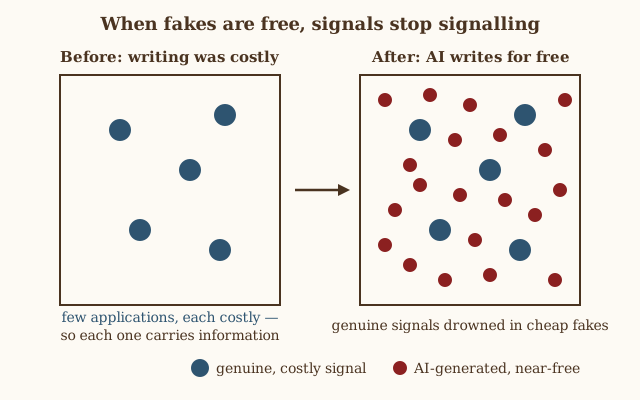
Akerlof’s framework also predicts what happens next: markets do not die, they re-equip with costlier signals. Employers are reverting to what cannot yet be generated (live interviews, supervised work trials, proctored tests) and leaning harder on referral networks and reputation, signals accumulated too slowly to fake. Universities rediscover the oral examination, the medieval technology that survives because it is unforgeable. Each fix works by restoring a cost gap between the honest and the fraudulent, and each makes screening more expensive than it was. The flood of free content does not make information free; it makes trust dear. Verification (of identity, provenance, authorship) becomes the scarce, valuable complement, as chapter 2’s logic predicts.
A subtler information problem arrives with AI agents themselves. When your assistant is a model trained, owned and updated by someone else, an old question returns: whose interests does the agent serve? Economists call it the principal-agent problem: the estate agent who pushes a quick sale, the broker paid by the fund he recommends. An AI assistant that books your travel and filters your news sits in the same seat, with the difference that its incentives are buried in training objectives and commercial partnerships you cannot inspect. This is why economists increasingly describe AI alignment (the problem of getting a system to pursue the goals its user actually wants) as mechanism design, the craft of building incentives so that an agent serves its principal, rather than a purely engineering problem.
The same uncertainty cuts both ways in shops. Firms have long used data to estimate each customer’s willingness to pay and edge prices towards it; AI sharpens the toolkit, and adds manipulation: interfaces and chat-salesmen tuned to your weak moments. But the consumer can now field an agent too: software that reads the fine print, compares every offer and haggles without fatigue or embarrassment. Whether the coming negotiation between firms’ algorithms and consumers’ algorithms tilts the balance of power, and in whose favour, is one of the open questions of the field.
So the used-car market does not collapse when the lemons learn to write; it gets re-engineered, at a price. Akerlof’s deeper lesson was always institutional: warranties, brands, certification and reputation exist because information is asymmetric, and when the asymmetry shifts, the institutions are rebuilt. The cost of being believed has gone up. Economics says somebody will get paid, handsomely, to bring it back down.
What to watch
- Employer screening practices: the shift back to interviews, work trials and proctored assessments, costly signals replacing destroyed cheap ones.
- Adoption and pricing of verification tools: content-provenance standards, identity checks for video calls, “proof of personhood” schemes.
- Reported losses from deepfake-enabled fraud in corporate and consumer scams.
- Whether platforms reintroduce costly signalling directly: fees, deposits or caps on applications and listings.
Dig deeper
- The Market for “Lemons”, George Akerlof, Quarterly Journal of Economics, 1970: the founding paper of information economics, and still the best ten pages on why markets need trust.
- Artificial Intelligence, Firms and Consumer Behavior: A Survey, Abrardi, Cambini & Rondi: what the evidence says about AI, pricing and consumers.
- Hiring is stuck in an “AI doom loop”, Fortune: the labour market’s signalling breakdown, from both sides.
- Job seekers flood LinkedIn with 11,000 applications a minute, eWeek: the numbers behind the application deluge.
- The Economics of Transformative AI, NBER/University of Chicago Press: includes the mechanism-design view of alignment used in this chapter.