Ask the world’s best economists what AI will do to growth and the answers differ by a factor of twenty. Daron Acemoglu of MIT works through the arithmetic and finds that today’s AI should add no more than about 0.7% to total factor productivity (a broad gauge of how efficiently an economy turns inputs into output) over a whole decade, a rounding error. Goldman Sachs, looking at the same technology, projects that it could eventually lift global GDP by around 7%, with productivity growth raised by some 1.5 percentage points a year for a decade, cumulatively about twenty times Acemoglu’s figure. Both camps are numerate, both have seen the same demonstrations, and trillions of dollars of investment ride on who is right. The disagreement itself is the thing to understand, because it is not really about AI. It is about three assumptions you can learn to watch.
Such estimates are built from a surprisingly simple recipe. Take the share of economic tasks AI can affect, multiply by the cost saving on each affected task, and you have the productivity gain. Acemoglu’s bear case, the pessimist’s reckoning, feeds in modest numbers: roughly a fifth of American work tasks are exposed to AI, only about a quarter of those can be profitably automated soon, and the average saving on each is around 27%. Multiply the fractions and the decade’s gain is small. The bull cases assume more tasks become automatable as the technology improves, deeper savings per task, and, crucially, that displaced workers move into new productive work rather than nowhere. Nobody is making an arithmetic mistake. They are betting differently on how far three numbers move.
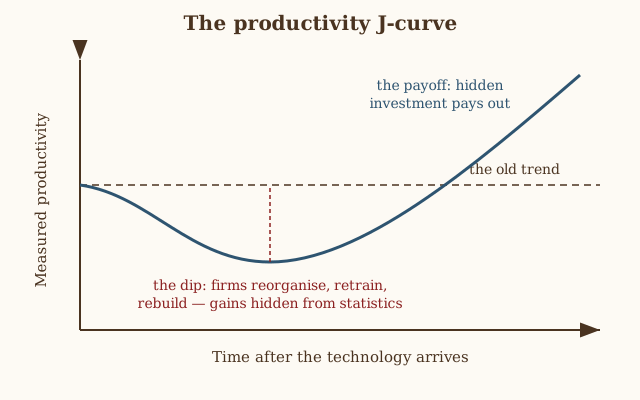
History supplies a reason to distrust early pessimism, and it has a name: the Solow paradox. In 1987 Robert Solow quipped that the computer age was visible everywhere except in the productivity statistics. He was right, and then he was wrong: a decade later productivity surged. The same lag had happened before. Chapter 1’s electric factories waited forty years, until engineers stopped bolting a giant motor where the steam engine had been and redesigned the whole plant around the new input. General-purpose technologies demand that firms reorganise, retrain and rebuild their processes before the payoff appears, and that rebuilding is itself costly.
Erik Brynjolfsson, Daniel Rock and Chad Syverson turned this lag into a shape: the productivity J-curve. In the early years of a general-purpose technology, firms pour effort into intangible investments (new workflows, new skills, new data) that national accounts barely count. Measured productivity therefore dips, or stagnates, precisely when the foundations of future growth are being laid; later, when the intangibles pay off, measured productivity overshoots. If AI follows the pattern, today’s unimpressive macro statistics tell us little: we may simply be in the trough of the J.
The micro evidence sits oddly alongside the macro gloom, which is exactly what the J-curve predicts. The randomised experiments of chapter 7 keep finding large gains for the individual worker: writing tasks done 40% faster, customer-support agents handling about 15% more queries, developers completing roughly a quarter more tasks. Yet one careful 2025 trial found experienced open-source programmers actually slower with AI assistance, and consultants in another study did worse when they trusted the tool outside its competence. Gains this uneven do not add up to national statistics until firms learn where the technology works, rewire themselves around it, and stop using it where it fails. That learning is the intangible investment in the dip.
Even the bulls, though, run into a speed limit named after William Baumol. His “cost disease” begins with an observation: a string quartet takes as long to play today as in 1800, yet musicians’ wages have risen with everyone else’s. When some sectors race ahead, the laggards do not fade away. They swell as a share of spending, because their relative prices rise and many of them, such as care, education and construction, are things we cannot do without. Philippe Aghion, Benjamin Jones and Chad Jones put the point sharply for AI: growth ends up constrained not by what we do well but by what is essential and hard to improve. If AI makes software and paperwork nearly free while nursing, construction and energy crawl, the economy’s overall speed is set by the crawlers.
There is one way past Baumol, and it is the radical scenario. Everything above treats AI as a better tool for producing goods and services. But ideas are also produced, by researchers, with effort and time, and if AI enters the ideas production function, helping to invent the next round of technologies including its own successors, growth compounds on growth. Economists have long called such a technology “an invention of a method of inventing”; electricity was not one, the research lab arguably was, and AI might be the most powerful yet. Aghion, Jones and Jones show that explosive growth is possible in such models, but only if no essential research step stays stubbornly human: Baumol’s logic, lurking even inside the laboratory.
A final reason for humility: our ruler is bent. GDP counts what is bought and sold, and much of what AI delivers is neither: free drafting, free translation, free tutoring, the consumer surplus of an assistant that costs $20 a month and replaces services that once cost hundreds. The same problem dogged the smartphone era: by some measures the digital economy’s largest gifts never appeared in the accounts. If AI’s gains arrive disproportionately as free goods, the productivity statistics could stay grey while life visibly brightens.
So the trillion-dollar question stays open, but it is no longer vague. The bears are betting that the affected task share stays small and Baumol bites early; the bulls, that the J-curve turns and tasks keep falling to the machine; the radicals, that AI starts inventing. Those are observable bets. If this book must place its own, it is this: the micro evidence is too strong, and the history of general-purpose technologies too consistent, for the bear case’s near-zero to hold; but the gains will arrive on electricity’s timetable, not the stockmarket’s, and Baumol will claim his share. Watch the three numbers (tasks affected, savings per task, and whether AI shows up in the business of discovery itself) and you will know who is winning the argument years before the statisticians do.
What to watch
- Official productivity statistics in heavy-adopting sectors (software, finance, professional services) versus laggards: the first place a J-curve upturn would show, as of mid-2026 still ambiguous.
- The share of tasks firms report profitably automating, in adoption surveys such as the US Census Bureau’s: the number that separates Acemoglu from Goldman.
- Prices in Baumol sectors: if care, construction and education keep getting relatively dearer, the speed limit is binding.
- Signs of AI in the ideas business: AI-assisted drug candidates, theorem proofs and chip designs reaching production.
Dig deeper
- The Simple Macroeconomics of AI (Acemoglu, NBER): the bear case, with the task arithmetic laid bare.
- AI’s Economic Potential: Goldman Sachs Responds to Acemoglu (AEI): the two camps argue directly, usefully summarised.
- The Productivity J-Curve (Brynjolfsson, Rock & Syverson, NBER): why general-purpose technologies understate themselves early.
- Artificial Intelligence and Economic Growth (Aghion, Jones & Jones, NBER): Baumol’s cost disease as the brake, and the conditions for explosive growth.
- Experimental Evidence on the Productivity Effects of Generative AI (Noy & Zhang): the micro gains the macro numbers have yet to digest.