The bosses of the big technology firms agree, in public and at length, that the pace of AI spending cannot last. Then, each quarter, they raise it. The four largest spent a record of roughly $400bn on capital projects, mostly AI data centres, in 2025; their guidance for 2026 runs to around $650bn, with some analysts’ tallies higher still, as of mid-2026. Set against that, American consumers were spending barely $12bn a year on AI services. Shareholders grumble, chief executives muse aloud about bubbles, and the spending climbs. Are some of the world’s most calculating managers being irrational?
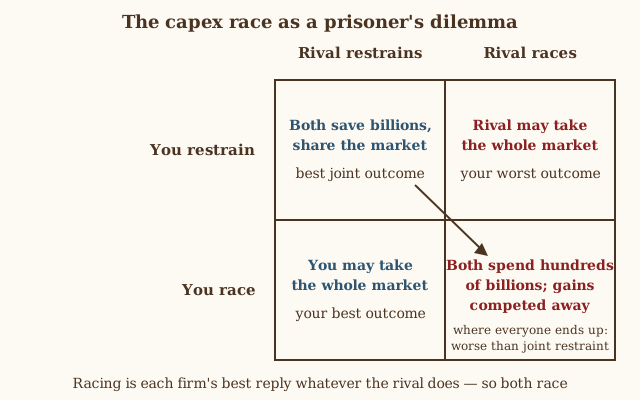
Game theory, the branch of economics that studies decisions whose payoff depends on what others decide, says no, and that is precisely the problem. The situation is a textbook prisoner’s dilemma. If all the big firms restrained their spending, each would keep a healthy share of a growing market and tens of billions in cash. But if your rival races while you restrain, and the prize turns out to be winner-take-most, as chapter 5’s scale economies and network effects suggest it might, you lose nearly everything. Racing is therefore each firm’s best reply no matter what the others do: it protects you if they race, and steals a march if they don’t. So everyone races, hundreds of billions are spent, and much of the eventual gain is competed away. Each move is individually rational; the outcome is collectively extravagant. The bosses are not mad. They are trapped.
A winner-take-most prize does something strange to investment arithmetic: it can justify bets that will most probably be written off. If the pot is large enough, call it the franchise on cheap machine intelligence, a small chance of winning it can carry a large chance of losing $100bn and still leave the gamble worth taking; oil majors drill mostly dry holes on the same logic. The difference is that in an arms race the size of everyone’s stake ratchets up with everyone else’s, so the contestants’ combined spending can sail past what the prize will ever repay. Each bet is sensible alone; the total is a collective overpayment.
Game theory also explains why so much of the race is conducted through announcements. Declaring a gigantic data-centre campus years before it opens is not boasting; it is commitment and pre-emption, a signal to rivals that the territory is claimed and that matching you will cost more than it returns. The same logic illuminates the era’s strangest deals, the circular ones. Nvidia has pledged to invest up to $100bn in OpenAI, which uses the money to buy Nvidia chips; OpenAI signed a compute contract with Oracle reported at about $300bn over five years, which Oracle fulfils largely by buying Nvidia chips; AMD granted OpenAI warrants (the right to buy shares at a set price later) over up to 10% of itself, at a cent a share, in exchange for OpenAI’s custom, all as of mid-2026. Read as strategy, these are commitment devices: each party locks the others into the race, making retreat contractually painful and the commitment therefore credible. Read as accounting, they are red flags. When a supplier finances its own customers’ purchases, reported demand and real demand can drift apart, as telecoms-equipment makers demonstrated expensively in the late 1990s.
Is the prize worth it? The value of being first depends on whether a lead can be defended. Where network effects and switching costs lock customers in, six months ahead can compound into a franchise; that is the bet the racers are making. But AI leads have so far proved leaky. DeepSeek, the fast follower of chapter 5, matched much of the frontier at a claimed fraction of the leaders’ cost; techniques and talent diffuse; smaller models learn by imitating bigger ones. If the follower’s discount is that deep, the first-mover’s prize shrinks, and the dilemma sharpens, because the racers are then overpaying for a lead the structure of the industry cannot protect.
There is a second, quieter game running beneath the loud one, and it points the other way, towards cooperation that nobody agreed to. In a study published in the American Economic Review in 2020, Emilio Calvano and colleagues let simple pricing algorithms compete in a simulated market. Left to learn by trial and error, the algorithms settled on prices well above the competitive level, and enforced them: when one cut prices, the others punished it, then guided prices back up. No communication, no agreement, no smoke-filled room, nothing a cartel prosecutor could point to, since collusion law hinges on proving an agreement. As more of the economy’s prices are set by machines that watch each other, firms could find themselves racing furiously in capacity while their algorithms, unbidden, make peace on price.
So the resolution of the puzzle is uncomfortable: the spending race is not irrationality but rationality, aimed at a prize of uncertain size, financed in ways that blur how real the demand is. Races like this end in one of three ways. The prize arrives and vindicates the spending; capital markets refuse to fund another lap; or the players find a way, tacit or otherwise, to stop. Game theory cannot tell you which. It can tell you what to watch.
What to watch
- The gap between the big four’s capital spending and their operating cash flow, and how much of the spending migrates to debt and off-balance-sheet vehicles.
- New circular deals: suppliers investing in customers who buy their products. More circularity means reported demand is a less reliable signal.
- Whether any major firm visibly cuts AI capex without being punished by markets, the first sign the dilemma’s payoffs have changed.
- Competition authorities’ first cases on algorithmic pricing, where no human ever agreed to collude.
Dig deeper
- A guide to the $1trn of AI deals between OpenAI, Nvidia and others, CNBC: a map of the circular-deal web.
- Artificial Intelligence, Algorithmic Pricing, and Collusion, Calvano et al., American Economic Review: the experiment in which pricing algorithms learnt to collude.
- AI’s trillion-dollar deal wheel, The Register: a sceptical tour of the circular economy of AI.
- This Is How the AI Bubble Will Pop, Derek Thompson: the financing channels through which a race becomes a bust.
- Concentrating Intelligence, Korinek & Vipra, NBER w33139: why the prize might really be winner-take-most.