Hardly anything in economic history has fallen in price like machine thinking. When OpenAI launched GPT-4 in March 2023, it charged $30 to read a million “tokens” (the word-fragments models are metered in, roughly 750,000 words). Within two years, models matching or beating it cost a few percent of that. The research group Epoch AI, which tracks these prices, finds that the cost of getting a fixed level of AI performance has been falling at somewhere between ninefold and several-hundredfold per year depending on the task, a median of roughly fiftyfold a year, as of mid-2026. Moore’s law, the engine of the computer age, managed a doubling every two years. So here is the question this chapter answers with one diagram: when the price of something falls like that, what happens to how much of it people buy, and to the people who used to sell the human version?
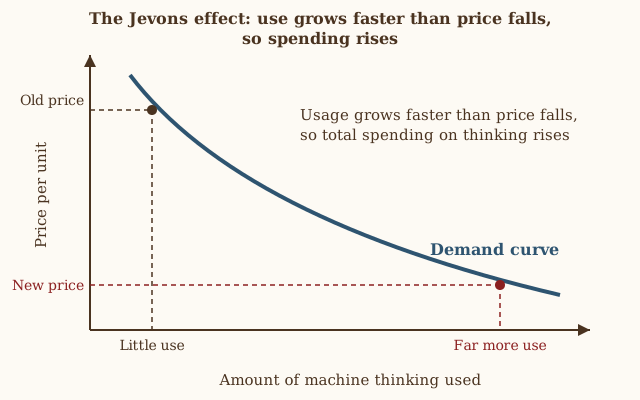
The diagram is the demand curve, the oldest tool on the economist’s shelf. It plots a simple relationship: the lower the price of a good, the more of it people buy. Not because anyone’s tastes change, but because at each lower price, new uses become worth it. At $30 per million tokens, you might use a model to draft important contracts. At 30 cents, you let it read every contract you have ever signed, summarise your meetings, check your code as you type and translate your website into forty languages. Economists call this a movement along the demand curve: same product, same buyers’ preferences, vastly more bought because the price asks so much less. And the curve itself is also shifting outward. As models improve and people discover what they can do, buyers want more at any given price. Falling price and rising demand together produce the explosion in usage the world has watched since 2022.
How much usage rises when price falls is captured by a number economists call elasticity, the responsiveness of demand to price, and it carries the chapter’s central insight. If a 10% price cut raises usage by less than 10%, total spending on the good falls: the good is a dying business. If usage rises by more than the price fell, total spending rises even as each unit gets cheaper. The economist William Stanley Jevons spotted this in 1865: more efficient steam engines, he argued, would increase Britain’s coal consumption, not reduce it, because cheaper steam power would find so many new uses. He was right, and the pattern that bears his name keeps recurring. Cheaper computing led to more total spending on computing, not less. So far, cheaper machine cognition is following the script: prices per unit have collapsed while total revenue from AI services has grown, because usage has grown faster than prices have fallen.
The same logic offers a first, partial answer to the question everyone actually cares about: will AI destroy work? The demand curve says the answer depends on what happens to the demand for the underlying service when its price falls. Cash machines are the classic case. They automated the bank teller’s defining task, dispensing money, and the number of tellers needed to run a branch duly fell, from about twenty to thirteen in urban America between 1988 and 2004. But cheaper branches meant banks opened more of them (43% more in urban areas) and teller employment edged up over thirty years, while the job itself shifted towards advice and sales. Automation cut the labour per unit; elasticity raised the number of units. Whether AI plays out the same way for writers and programmers depends on whether the world’s appetite for words and software grows as fast as machines cut their cost. Nothing guarantees it will, and chapter 7 returns to the cases where it has not. But the lesson stands: you cannot reason from “a machine now does the task” to “the job disappears” without knowing the elasticity of demand.
The second thing a demand curve does is sort every other good in the economy into two piles: substitutes, the things that can replace it, which fall in value when prediction gets cheap, and complements, the things used alongside it, which rise. Substitutes are whatever the cheap thing replaces: above all, human effort devoted to routine prediction and routine drafting. Complements are whatever you need more of when you use more of the cheap thing. Agrawal, Gans and Goldfarb, the economists who built this framing, point to judgment: a model can predict, but deciding what to do with the prediction (what to ask, what counts as success, when to overrule the machine) remains human, and becomes more valuable as predictions multiply. Proprietary data is a complement, because models are only as good as what they are fed. So is taste, the ability to tell good output from plausible output. The career advice of the AI era falls straight out of the diagram: move yourself from the substitute pile to the complement pile.
The final move is to see that most of the AI economy is demand one step removed. Nobody wants a graphics chip for its own sake; Nvidia’s order book is the demand for intelligence, expressed in silicon. The same goes for the data centres and the electricity that runs them: the International Energy Agency projects that data centres will consume around 945 terawatt-hours by 2030, more than Japan’s entire current electricity use, driven chiefly by AI. Economists call this derived demand, and it explains why a software boom is being felt by electricians, turbine-makers and the residents of data-centre towns. When the price of thinking falls far enough, the scarce things become the physical ones. That chain of inputs (compute, data, talent, power) is the subject of the next chapter.
What to watch
- Epoch AI’s inference price tracker: whether the fiftyfold-a-year decline in the price of fixed capability persists, slows or stalls.
- Total revenue of AI model providers versus their prices: rising revenue alongside falling prices means the Jevons effect is still winning.
- Employment and output in heavily exposed occupations (software, translation, copywriting): is the volume of work growing fast enough to offset cheaper output per task, as it did for bank tellers?
- Electricity demand from data centres (IEA and national grid-operator reports) as the cleanest physical measure of derived demand for intelligence.
Dig deeper
- LLM inference prices have fallen rapidly but unequally across tasks (Epoch AI): the price-decline data behind this chapter’s opening puzzle.
- The Simple Economics of Machine Intelligence (Harvard Business Review, 2016): the substitutes-and-complements framing in five pages.
- Prediction Machines, updated edition (Agrawal, Gans & Goldfarb): the book-length version, including why judgment and data gain value.
- Toil and Technology (James Bessen, IMF Finance & Development, 2015): the cash-machine-and-teller story and what it teaches about automation and demand.
- Energy and AI (IEA, 2025): the derived-demand chain made physical: AI’s projected claim on the world’s electricity.