In the first three quarters of 2025, spending connected to AI contributed about one percentage point to American GDP growth. That was 39% of all the growth there was, a bigger share than information technology managed at the height of the dot-com boom, by the St. Louis Fed’s count. On their own guidance, the biggest cloud companies have pencilled in around $650bn of capital spending for 2026, and on some tallies more (as of mid-2026). Against this stands the small number chapter 6 met: American consumers spend roughly $12bn a year on AI services. A torrent of investment, a trickle of revenue. The word everyone reaches for is “bubble”, and the economist’s first job is to explain why that is the wrong question.
An investment boom is, at bottom, a bet about timing. Firms spend today because they expect profits tomorrow; the spending itself becomes today’s demand, today’s construction jobs, today’s GDP. A wide gap between outlay and current revenue is not irrational on its face: every railway was a hole in the ground before it was a railway. The trouble is that expectations feed on each other. When everyone expects the same golden future, asset prices rise, which validates the expectation, which raises prices further, and capacity gets built for a demand curve that exists mainly in spreadsheets. Carlota Perez, the economist who studied this pattern across two centuries, found it in canals, railways, electrification and the internet: technological revolutions arrive with a financial mania, the mania overshoots, the crash transfers wealth from late investors to early ones, and then, on the cheap surviving infrastructure, the technology’s real golden age is built. Britain’s railway mania of the 1840s ruined thousands of shareholders and left Britain with railways. The 1990s telecoms bust vaporised hundreds of billions, and the dark fibre laid in the frenzy later carried YouTube for a song.
So the productive question is not “is it a bubble?” (manias and transformations are usually the same event) but “what survives the pop?”. And here AI differs from its ancestors in a way that should temper the comfort of history.
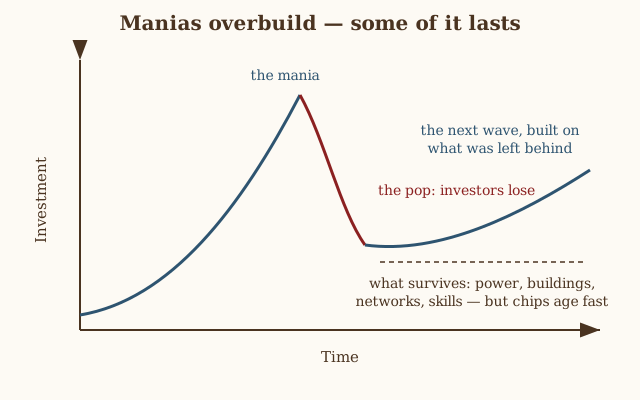
The difference is depreciation. Rails last a century; fibre, decades. The heart of AI capital spending is chips, and chips age like fish, not wine. Hyperscalers currently spread the cost of their AI servers over five to six years in their accounts, while sceptics, most loudly the investor Michael Burry, argue the true economic life of a top-end chip is nearer two or three, since each new generation makes the last uncompetitive; on his arithmetic the industry will understate depreciation by some $176bn between 2026 and 2028, flattering reported profits (as of mid-2026, an open and bad-tempered controversy). The models themselves are worse: a frontier model is commercially stale within months. If the boom busts, the residue may be the boring parts (power plants, grid connections, cooling, buildings, and a generation of engineers who know how to run them) while the expensive silicon at the centre quietly writes itself off.
The financing plumbing decides who gets hurt. Some of it has a circular look that veterans of past manias recognise: chipmakers investing billions in AI labs that spend the money on their chips, booking the same dollars as both investment and revenue. Data-centre construction is increasingly funded by debt and private credit rather than cash flow, which is how a sectoral disappointment becomes a financial event. And the stock market’s gains are concentrated in a handful of AI-linked firms, so that ordinary pension savers are exposed to the boom whether they chose to be or not. These are the channels to watch, because bubbles do their damage not through the technology but through the balance sheets that financed it.
The counter-case deserves its full weight, because it is strong. Jerome Powell, the Fed’s chairman, made the obvious contrast with 1999: the firms doing today’s spending “actually have earnings”. They are the most profitable companies in history, funding their capital spending largely from cash flow rather than speculative debt. AI revenue, though small beside the capex, is real and growing fast, not a promise on a sock puppet’s website. Derek Thompson, a careful chronicler of the debate, notes that annual AI infrastructure spending of roughly $400bn in 2025 stood against the $12bn or so American consumers pay for AI services, a gap of more than thirty to one, far wider than anything telecoms or the railways ran up. That comparison can be read either way: the gap is historically extreme, or the spenders are historically able to afford it.
Economics cannot tell you, in advance, whether this is a bubble; nobody can, which is rather the point of bubbles. What it can do is replace one unanswerable question with three answerable ones. Is the spending financed by cash flows that can absorb disappointment, or by debt that cannot? Are the accounts depreciating the assets as fast as the technology actually ages? And how much of the installed base would still be useful at half today’s demand, the residue question? Railways, electricity and fibre all said: investors lose, society keeps the infrastructure. AI may yet follow the script. But it is the first technological mania whose central asset has the shelf life of a smartphone, and that is a genuinely new line in a very old play.
What to watch
- The financing mix of data-centre construction: the share funded by debt and private credit rather than hyperscaler cash flow, the channel that turns a disappointment into a crisis.
- Depreciation schedules in hyperscaler accounts: any move to shorten assumed chip lives signals the profit-flattering era is ending.
- AI revenue growth against capex: the thirty-to-one gap between infrastructure spending and consumer AI revenue (as of mid-2026) must narrow from the revenue side, or the spending side will do it abruptly.
- Utilisation and pricing of rented AI computing power: falling rental prices for chips would be the first hard evidence of overcapacity.
These signals can be watched, and so can the deeper questions beneath them. The appendix, From anecdote to accounting, turns this chapter’s three questions into three running numbers: how much fuel a crash would run on, how short the fuse, and how much would be salvaged. They are kept up to date on a live dashboard, The Return on Thinking, at returns.priceofthinking.com, where every figure is traceable to a public source.
Dig deeper
- Tracking AI’s Contribution to GDP Growth (St. Louis Fed): the source for AI investment’s share of American growth.
- This Is How the AI Bubble Will Pop (Derek Thompson): the capex-versus-revenue arithmetic, clearly told.
- Will AI Investments Pay Off? (Richmond Fed): a central banker’s sober survey of the boom.
- Why AI Companies May Invest More than $500 Billion in 2026 (Goldman Sachs): the bull case for the build-out.
- How long before a GPU depreciates? (CNBC): the depreciation controversy explained.
- AI bubble (Wikipedia): a running, well-sourced chronicle of the whole debate.