In October 2022 America forbade the sale of its most advanced AI chips to China, its chipmakers’ largest foreign market, and Beijing answered with a state-backed crash programme to build its own. Three years later Washington partially relented: under rules issued in January 2026, Nvidia may sell its H200 chip to Chinese buyers provided the American state takes a 25% cut of the proceeds. Beijing, having spent the interval weaning its firms onto home-grown silicon, responded by discouraging them from buying (as of mid-2026). Each side now pays more for what it used to get cheaply from the other. Who won?
The tool for this puzzle is comparative advantage: countries prosper by producing what they make relatively cheaply and trading for the rest, the insight that has underwritten two centuries of argument for open commerce. AI’s inputs map onto it neatly: capital is abundant in America, cheap power in the Gulf and parts of China, engineers everywhere talent is schooled, data wherever people live their lives online. Trade theory would have each country specialise. But AI breaks one of the theory’s quiet assumptions. The scale economies of chapters 4 and 5 mean production does not spread to wherever it is cheapest; it clumps where the fixed costs and know-how already sit. The result is a supply chain more concentrated than almost anything else in the world economy.
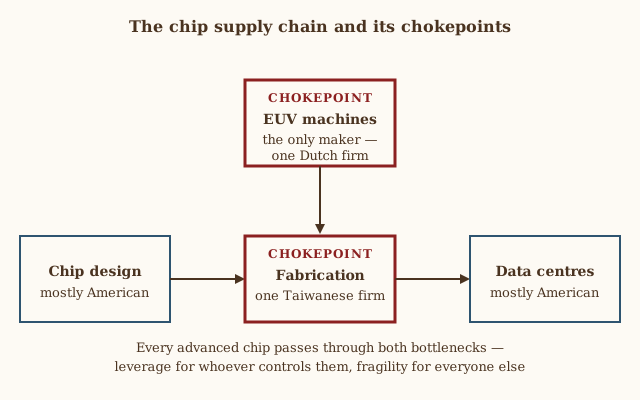
How concentrated? The designs are mostly American. Every machine capable of printing the most advanced chips, using extreme-ultraviolet lithography, a technology that took three decades to master, comes from a single Dutch company, ASML. Most of the world’s leading-edge chips are then fabricated by a single Taiwanese company, TSMC, which as of mid-2026 collects roughly two-thirds of global contract chipmaking revenue, much of it on one island within range of Chinese missiles. Economists call these chokepoints, and they cut both ways: leverage for whoever controls them, fragility for everyone who depends on them. The 2022 export controls were the leverage being used.
What does economics say about using it? An export ban is a tax that both sides pay. The seller loses its largest market (Nvidia has forgone billions in Chinese revenue) and the buyer pays more for worse substitutes; the difference between what both sides would have gained from trade and what they get instead is pure loss, what economists call deadweight. Bans also leak: chips have been smuggled, and Chinese firms can rent American computing through the cloud. Most important, a ban is an infant-industry subsidy to the very rival it targets. Huawei’s chip business was handed, free of charge, the one thing infant industries always lack: a captive home market with the foreign competition locked out. The infant is growing but still small: independent estimates suggest Huawei’s best accelerator delivers roughly 60% of the performance of the chip Nvidia was selling in 2022, and that Huawei’s total output amounts to a few percent of Nvidia’s computing power (as of mid-2026). The controls have preserved America’s lead. They have also guaranteed that China never stops trying to close it.
Score the contest honestly and nobody has won; both have bought insurance at a stiff premium. America kept its compute advantage and paid in lost sales, leakage and its reputation as a reliable supplier, a reputation that, once spent, sends every customer looking for a second source. China lost access to the best chips today in exchange for an industry it might own tomorrow. And the January 2026 settlement reveals the new logic plainly: trade is permitted when the state gets its cut. Sixteenth-century mercantilists, who measured national power by the bullion in the treasury and taxed trade to fill it, would recognise the 25% levy instantly. Economists spent two centuries explaining why they were wrong; the argument has evidently reopened.
The same logic now runs through subsidies. America’s CHIPS Act committed $52.7bn to rebuilding domestic chipmaking, and in August 2025 Washington went further, converting $8.9bn of Intel’s grants into a 9.9% government shareholding: the state not merely as referee but as part-owner of a national champion. Europe, Japan, India and the Gulf states have their own versions. The economics of subsidy races is well rehearsed: when one country subsidises a strategic industry, others retaliate, and the predictable end-state is overcapacity and falling prices, as the world’s experience with subsidised steel, ships and solar panels attests. Some of this spending buys genuine security: chips really are a military input, and an earthquake or blockade in Taiwan really would be a global emergency. The economist’s discipline is simply to ask, of each billion, whether the same security could be bought cheaper: stockpiles, second sources and friendly-country capacity all compete with the prestige of a fab at home.
The bystanders in this contest are the countries that joined the world economy by selling inexpensive labour. Chapter 10 argued that AI erodes precisely that advantage, and the chip war adds a second blow, since a world that treats computing as a strategic asset will not site much of it in poor countries, and may treat their data as a resource to extract rather than an asset they own. The hopeful counter-case is real: models let a clinic in Kigali or a one-room school consult expertise that once lived only in rich capitals, a technology that, unusually, exports skill rather than competing with cheap hands alone. Which effect dominates will depend on electricity, connectivity and institutions, the complements, as ever, deciding who benefits from the substitute.
So the answer to the opening question is that both governments would say they won, and both are paying as if they lost. Specialisation is efficient and brittle; resilience is robust and dear; the new mercantilism has simply chosen to pay for resilience, plus a margin for politics. The chokepoint map will tell readers how the contest is going better than any communiqué, and it is worth remembering what the original mercantilists learned the hard way: hoarding bullion made states feel strong and grow poor. At least gold kept its value. Chips depreciate in a few years, which makes computing a strange treasure to hoard, and patience a surprisingly strategic asset.
What to watch
- Whether Chinese firms actually buy the permitted Nvidia chips or hold the line on home-grown silicon, the cleanest test of how far the infant industry has grown.
- Huawei’s and SMIC’s output volumes and chip quality each year: the gap to Nvidia and TSMC, and whether it narrows.
- The share of TSMC’s leading-edge production sited outside Taiwan, the price of resilience being paid down.
- Whether the 25%-cut model spreads to other strategic industries; if it does, the new mercantilism is policy, not improvisation.
Dig deeper
- Goldfarb & Trefler, “AI and International Trade” (NBER w24254): comparative advantage and scale economies applied to AI.
- Council on Foreign Relations, “China’s AI Chip Deficit”: the case that export controls are working, with the Huawei numbers.
- Council on Foreign Relations on the consequences of exporting Nvidia’s H200 to China: the January 2026 policy shift examined.
- Institute for Progress, “Should the US Sell Blackwell Chips to China?”: the chip-export trade-offs argued from first principles.
- Manufacturing Dive on the US government’s Intel stake: how CHIPS Act grants became a 9.9% shareholding.
- Chris Miller, Chip War (2022): the indispensable history of how the supply chain became geopolitics.