A chatbot released in November 2022 reached a million users in five days, a hundred million in two months, and, by early 2026, more than 900m active users a week. In its wake, the world’s biggest technology firms began spending on a scale normally reserved for wars and railways: an industry-wide build-out of chips, data centres and power running at more than $500bn a year, as of mid-2026, with forecasts rising. The figure comes from the spenders’ own audited accounts, not just bankers’ bullish presentations. Global spending on data centres now exceeds what the world spends developing new oil supply, according to the International Energy Agency. For a product whose visible face is largely a text box that answers questions, the sums look mad.
Computer science cannot tell you whether they are. It can explain how a large language model works (roughly, a machine for predicting the next word, trained on most of the written internet) but not why that should reorganise the world’s capital spending. The question “is half a trillion dollars a year a sensible response to a chatbot?” is not a question about software. It is a question about prices, inputs, competition and expected returns. It is, in other words, an economics question, and an old one.
The first thing economics offers is a category. AI belongs to a small family that economists call general-purpose technologies: inventions like the steam engine, electricity and the computer that are useful almost everywhere, keep improving for decades, and spawn waves of complementary inventions. The steam engine was not a better pump; it was a new kind of input that remade factories, transport and cities. Electricity was not a better gas lamp. The test of a general-purpose technology is not what it does on day one but how many other things have to be reinvented around it. By that test AI qualifies: the same underlying models are being threaded into medicine, law, software, logistics and science, and each use spawns further uses.
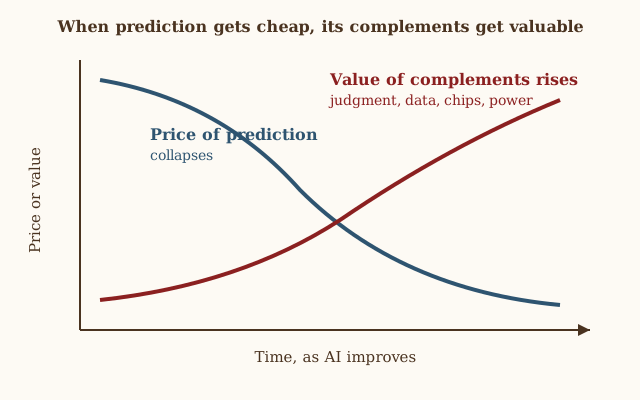
The second, sharper offering is the argument that runs through this book. Strip away the science fiction and what has actually happened is simple: the price of a previously scarce input has collapsed. The input is prediction: filling in missing information, whether the missing piece is the next word of a contract, the diagnosis behind a scan, or the code that completes a half-written program. Increasingly the cheap input looks like cognition itself. Today’s models draft, summarise and design as well as predict, and the label has begun to strain. The label matters less than the logic: whatever the machine is doing, it is a scarce input getting cheap, and the same price theory applies. Three economists, Ajay Agrawal, Joshua Gans and Avi Goldfarb, made this point before ChatGPT existed: treat AI not as magic but as a drop in the cost of prediction, and ordinary price theory tells you what to look for.
It tells you three things. When an essential input gets dramatically cheaper, usage explodes: people find uses that were unthinkable at the old price, just as cheap electric light turned night into usable time. Things that substitute for the cheap input fall in value; if a machine predicts well, paying a human to make the same routine prediction becomes harder to justify. And things that complement the cheap input rise in value: the judgment to act on a prediction, the proprietary data that feeds it, the chips and electricity that produce it. The half-trillion dollars stops looking mad and starts looking legible: it is a bet on the complements. Nvidia’s chips, Microsoft’s data centres and the power contracts of the American Midwest are valuable for one reason only. The world expects to consume vastly more prediction at the new, lower price.
Whether the bet pays off is a different question, and here economics offers its third gift: a warning from history. Every previous general-purpose technology took decades to show up in the productivity statistics. The economic historian Paul David showed why with electricity. American factories began installing electric dynamos in the 1880s, yet measurable productivity gains waited until the 1920s. The reason was not that electricity disappointed; it was that the gains required rebuilding the factory. Steam-era plants were stacked vertically around a central shaft. Electricity’s payoff came only when engineers redesigned them as single-storey buildings with a small motor at each workstation. That meant new buildings, new workflows and a new generation of managers who thought in terms of the new input. The technology was quick; the reorganisation was slow.
That lag is the recurring tension of this book. At any moment in an AI boom, the enthusiasts and the sceptics can both point to honest evidence (the enthusiasts to the technology’s measured capabilities, the sceptics to its missing macroeconomic footprint) and both be right, because the footprint of a general-purpose technology arrives late. As of mid-2026, AI sits exactly in that gap: capabilities racing ahead of any visible effect on national productivity figures. Economics does not resolve the tension by picking a side. It explains why the gap exists, how long such gaps have lasted before, and what would tell us this one is closing.
So the puzzle dissolves into a sequence of smaller, answerable questions, and they map the rest of this book. If prediction is now cheap, what happens to the demand for thinking, and to the people who used to supply it? If intelligence is made from chips, data and power, who controls the inputs? If a frontier model costs billions to build and almost nothing to copy, what kind of market does that create? Each is a standard economics question wearing new clothes. None requires you to understand a transformer. All of them require a demand curve, which is where the next chapter begins.
What to watch
- Hyperscaler capital spending in quarterly earnings reports (Microsoft, Alphabet, Amazon, Meta): still climbing, plateauing, or being cut. That is the cleanest signal of whether the complements bet is holding.
- Aggregate productivity statistics (US Bureau of Labor Statistics quarterly releases): the moment AI starts visibly moving total factor productivity, the “electricity lag” argument starts resolving.
- Adoption beyond chatbots: official surveys of business AI use (such as the US Census Bureau’s), which track whether AI is being threaded into ordinary firms or stalling at the experiment stage.
- The breadth test of a general-purpose technology: whether AI keeps spawning complementary inventions (new drugs, new materials, new software categories) or narrows into a few niches.
Dig deeper
- The Simple Economics of Machine Intelligence (Harvard Business Review, 2016): Agrawal, Gans and Goldfarb’s original statement of the “AI = cheap prediction” framing, written before ChatGPT.
- Artificial Intelligence and the Modern Productivity Paradox (NBER, 2017): Brynjolfsson, Rock and Syverson on why general-purpose technologies show up late in the statistics.
- The Dynamo and the Computer (Paul David, American Economic Review, 1990): the classic account of why electricity took forty years to pay off.
- Why AI companies may invest more than $500 billion in 2026 (Goldman Sachs): the scale of the capex boom, from a bank helping finance it.
- Tracking AI’s contribution to GDP growth (St. Louis Fed, 2026): how much of current American growth the AI build-out accounts for.
- The Economics of Artificial Intelligence: An Agenda (NBER/University of Chicago Press, 2019): the volume that set the research agenda this book draws on.