Two facts about the labour market are both true, and they point in opposite directions. Total employment in America has kept growing since ChatGPT arrived in late 2022. Yet Stanford economists reading records from ADP, a firm that runs payroll for millions of American workers, have found that employment of 22-to-25-year-olds in the occupations most exposed to AI, software development and customer service above all, has fallen by about 16% relative to comparable workers (as of mid-2026). Older people in the very same occupations have been fine. The machines are not taking the jobs; somebody is losing them anyway.
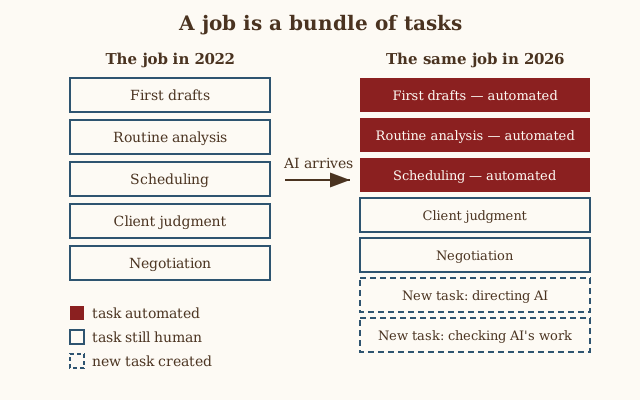
The contradiction dissolves once you stop counting jobs and start counting tasks. The most useful tool here, built by Daron Acemoglu and Pascual Restrepo, begins from a plain observation: a job is not a single thing a machine can take. It is a bundle of tasks. A customer-service agent answers routine queries, calms angry callers, spots fraud, escalates the hard cases and tells the product team what is going wrong. AI may do the first of those brilliantly and the rest badly. What happens to her job depends on the arithmetic of the bundle.
Three forces drive that arithmetic. Automation displaces: tasks the machine now performs no longer need a person. Productivity expands: when the machine makes a service cheaper or better, customers buy more of it, which raises demand for the tasks that stay human. And new tasks appear: every wave of automation has created work that did not exist before it. Chapter 2’s cash machines showed all three at once: counting money was automated, cheaper branches multiplied, and the teller’s job tilted towards selling and advising. The net effect of the three forces is not a law of nature. It is an empirical question, settled industry by industry.
Measured this way, AI’s reach is broad but shallow. When researchers at OpenAI and the University of Pennsylvania mapped language models against the task lists of American occupations, they found that about 80% of workers have at least a tenth of their tasks exposed, while roughly 19% have half or more. Headlines read this as a redundancy notice for a fifth of the workforce. It is nothing of the sort: it is a map of overlap, silent on whether the overlapping tasks will be done instead of you or alongside you.
The early evidence on “alongside” is striking, and it runs against the pattern of the computer era. In a randomised experiment, professionals given ChatGPT finished writing tasks 40% faster and produced work judged 18% better, and the weakest writers gained most. At a large software firm, an AI assistant raised the output of 5,172 customer-support agents by about 15% on average, but by roughly a third for the newest recruits; the system had, in effect, bottled the habits of the best performers and poured them into everyone else. Trials of AI coding assistants found developers completing about 26% more tasks, with junior developers again gaining most, though not every trial obliges: one careful experiment found seasoned open-source programmers actually slower with the tool, a result chapter 8 returns to. Where information technology rewarded those who already had skills, AI so far behaves more like a machine for distributing expertise.
Whether AI replaces or amplifies is therefore not a property of the technology but a choice about deployment, what Erik Brynjolfsson calls the Turing trap. A system designed and priced to imitate a worker invites managers to substitute it for one. A system designed to extend a worker invites them to expect more from her. The same model can be either, and the economics of the firm, not the silicon, decides which.
This is what the missing 22-year-olds reveal. The tasks AI does best, first drafts, boilerplate code, routine tickets, are the tasks firms hire novices to do. The Stanford study found the employment declines concentrated precisely in occupations where AI is used to automate work rather than to augment it, and only among the young, because juniors are the bundle with the most automatable tasks in it. That should worry their employers as much as them: senior judgment is learned by doing junior work, and a firm that automates its bottom rung has quietly burned the ladder. A caution, though, before the moral is drawn: the same young coders were also hit by post-pandemic tech retrenchment and dearer money, and the study’s authors are careful to call the pattern consistent with AI rather than proved to be its work.
A further trap sounds paradoxical: the worst outcome for workers is not brilliant AI but mediocre AI. Acemoglu and Restrepo call it “so-so automation”, technology good enough to displace people yet not good enough to raise productivity much. Supermarket self-checkout is the textbook case: cashiers go, queues stay, prices barely move. Displacement without the productivity effect means no expanding demand to reabsorb anyone.
History counsels patience, but honestly priced patience. The Luddites were not wrong about themselves: the skilled weavers who smashed the new frames really did lose their livelihoods, even though the factory economy eventually employed far more people at better pay. During the early industrial revolution, output per worker rose for decades before ordinary wages followed (economists call the gap Engel’s pause), and a pause of decades is most of a working life. The new tasks always came. They came late, and to other people.
So both halves of the puzzle stand. Aggregate employment grows because the productivity and new-task effects are real; young workers in exposed occupations shrink in number because displacement lands on their tasks first. The Stanford authors called them canaries in the coal mine, and the metaphor is exact: the bird’s job is not to predict the mine’s collapse but to give the miners time. What to do with the warning, design AI to extend workers or to imitate them, is the subject the rest of this book keeps returning to, because it is a choice.
What to watch
- Hiring rates for under-30s in exposed occupations (software, support, admin) relative to older workers in the same jobs: the canary indicator.
- Job postings for explicitly entry-level roles: do firms rebuild the bottom rung, redesign it around AI, or abandon it?
- The augmentation-automation split in adoption surveys: are firms buying AI to cut headcount or to raise output per head?
- New task creation: occupations and job titles that did not exist in 2022, and what they pay.
Dig deeper
- Canaries in the Coal Mine? Six Facts about the Recent Employment Effects of AI: the Stanford payroll study behind this chapter’s 16% finding.
- The Race Between Machine and Man (Acemoglu & Restrepo, NBER): the task model: displacement, productivity and new tasks.
- GPTs are GPTs (Eloundou et al., Science): the exposure map: 80% of workers with at least a tenth of tasks affected.
- Experimental Evidence on the Productivity Effects of Generative AI (Noy & Zhang): the writing experiment: faster, better, and most of all for the weakest.
- The Turing Trap (Brynjolfsson, Daedalus): why imitating humans biases AI towards substitution.
- Applying AI to Rebuild Middle Class Jobs (Autor, NBER): the optimistic case: AI as a distributor of expertise.